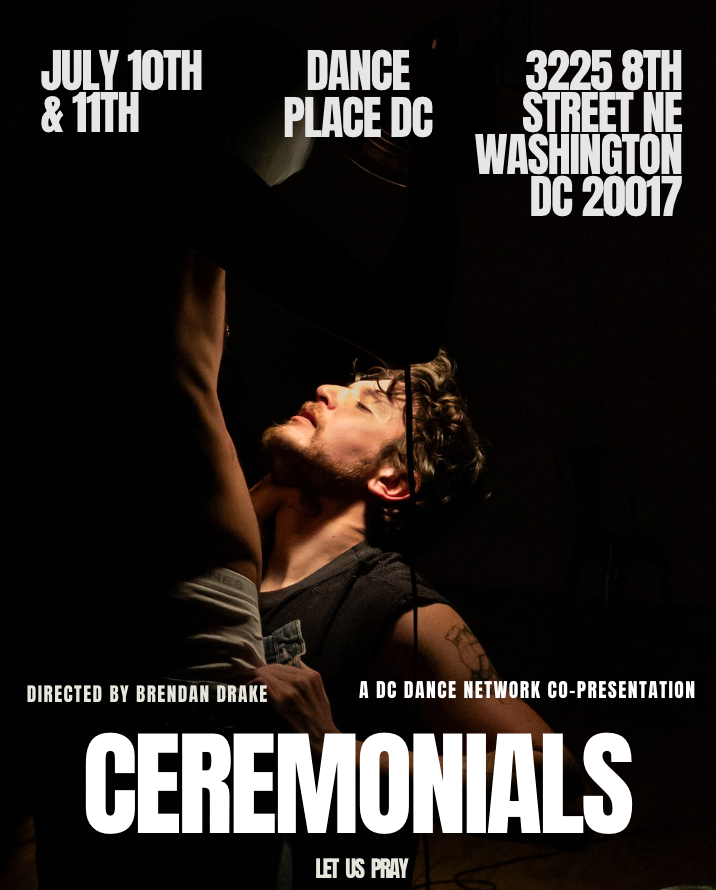
Join Dance Place on July 10th and 11th as choreographer and interdisciplinary artist Brendan Drake makes his Dance Place debut with Ceremonials, presented by DC Dance Network. Drawing inspiration from Catholic iconography and gay porn, Ceremonials is an hour-long performance work exploring the not-so-subtle similarities between Christianity and eroticism.
As part of our Artist Advisory Council interview series, Dance Place’s Audience and Community Engagement Apprentice, Juliana Pironti, sat down with Jane Raleigh (Founder of DC Dance Network) and Brendan Drake (commissioned artist) to delve into the DC dance landscape and the upcoming show at Dance Place: Ceremonials.
Part I: Introductions
Hello Jane and Brendan, could you introduce yourselves?
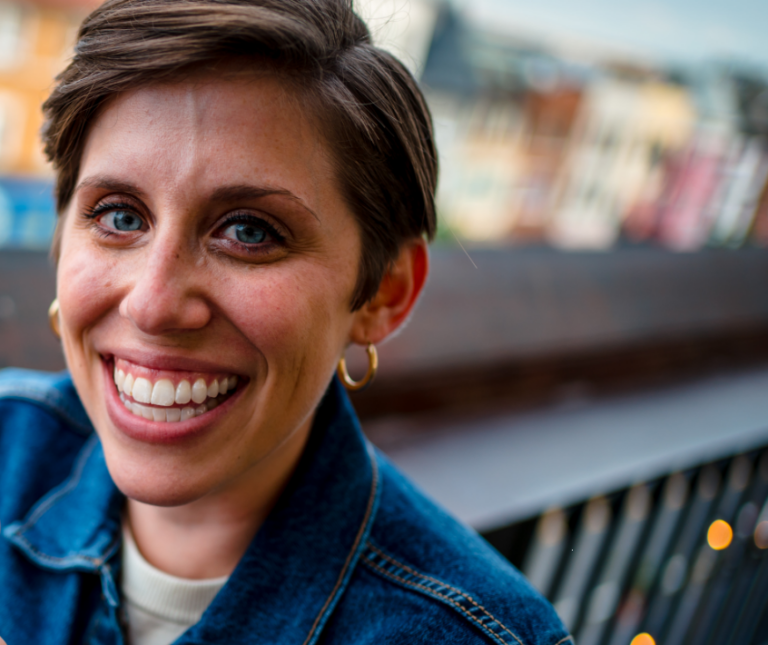
Jane: My name is Jane Raleigh. I am, in this capacity, the founder of DC Dance Network, who has commissioned Brendan Drake for this performance. I am from Washington, DC. I was born in the city but then grew up in Northern Virginia, and was a super ballerina bun head queen as I was going up through high school.
Then, by the time I was 16, I was, like, having that ballet experience where you go through puberty, and I was like, “This is not gonna happen. I’m not going to be a ballet dancer.”
I came back to D.C. after college and I had the intention of leaving the arts behind and going and doing Spanish. I wanted to be a Spanish interpreter for the UN. That was my ultimate goal. And pretty quickly I was like, “This is a horrible mistake. I should be back in the arts, which is everything that I love and know.”
So I ended up working at the Kennedy Center. I started as an intern there and then worked my way up to be director of dance programming there before I got fired under the Trump administration.
In that whole journey, I really learned how good it felt and how meaningful it is to be the administrator behind the curtain, helping support artists getting on stage.
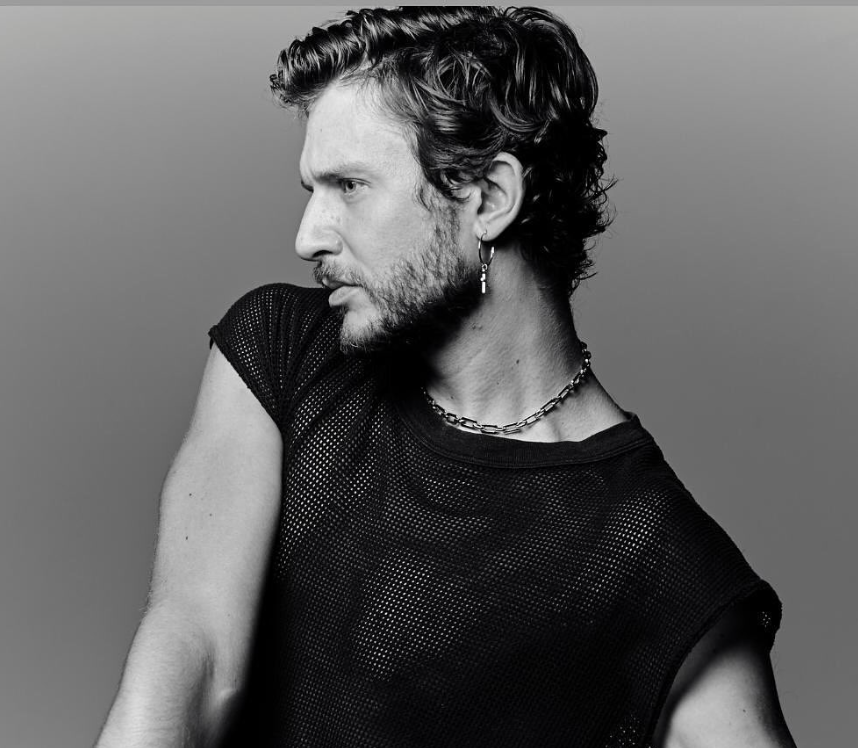
Brendan Drake: My name is Brendan Drake. I am originally from Western Massachusetts. Um, I am an interdisciplinary artist, choreographer, educator, curator, occasional writer, occasional performer. I lived in New York City for 13 years, I lived in LA for two, and I’ve lived in DC for the last 2 years. I moved here in fall 2024 to start a position as the Visiting Assistant Professor of Dance at George Washington University. Now I am setting some roots down because I am finding my way through a different arts ecosystem that has a lot to offer that I was craving. So, I’m enjoying the ride.
Part II: DC Dance Network
Jane, this is the inaugural year of DC Dance Network. So exciting. Congratulations. What was your specific want/need to start this project? What made you decide to focus on it being a choreographic commission instead of a mentorship or any other type of program?
Jane Raleigh: Yeah, great question. So because I’ve been in DC my whole life, I have seen that the opportunities that exist for local dance artists and choreographers have dwindled. When I first graduated college, I felt like there were more commission opportunities, more grants, more performances, more festivals, just more opportunities in general. And a couple years ago, I decided to put that on paper and sort of chart of what opportunities used to exist and how they have dwindled over time. What I’ve just seen is that over the last, like, 10 years, opportunities have gone away and no new opportunities have entered the mix.
So that was really the impetus for starting DC Dance Network: to just bring some new money, some new opportunities into the DC dance community, and to listen and offer what people actually are looking for.
The commission was the first project of DC Dance Network. It’s funny because originally, I was hoping that it would be a stepping stone to the Local Dance Commissioning Project, which existed at the Kennedy Center and now no longer exists at the Kennedy Center.
What about Brendan and what about the work or what he submitted, like, made you choose him for this specific opportunity?
Jane Raleigh: Yeah. So there was a full panel review process. It was an application and a panel review. I always love a panel review because even though it’s a lot of administrative work, it does help the strongest written applications rise to the top. When I am putting together a panel, I’m always interested in putting people together who hopefully don’t agree with each other on everything, so that you actually get a mix of opinions in the room, having a debate about the products. First and foremost, I’m grateful to the community members who lent their expertise to select him.
The thing that’s really exciting about this work, Ceremonials, is that it aesthetically falls outside, a little bit outside of what the DC dance community normally experiences. I’ve had a lot of really interesting conversations with Brendan about his work in New York, um, and how this, I would want Brendan to put the words to it, but to me, it’s like a little bit of downtown dance. It’s a little bit experimental. It’s a little like movement theater but dance forward.
And when I thought about what DC Dance Network and the type of work that DC Dance Network wants to support, I think we do not have a lot of opportunities in our region for people to take risks and do things that are outside of, like, the norm of what we see in DC. And so it felt very exciting when the panel was coalescing around Brendan’s application to be able to support his aesthetic. To bring something new to our audiences. It’s not new to the world, but it is new to DC, and expands that understanding of what dance is.
Dance Place’s theme for the 45th season is Home is Coming. How does that resonate with you and your current career path, career journey and the inaugural year of DC Dance Network?
Jane Raleigh: Having experienced all of what I experienced at the Kennedy Center last year through the takeover and destruction of the staff, it has made clear to me what I have known for a long time, which is that community and home is more centered in people than it is in a physical place. That’s become a real driving force for me with everything with the DC Dance Network is how to find the people that are craving community and put them together. Matchmake them in social situations, matchmake them in artistic situations, give them money so that they can continue to do the work that they’re already doing.
That shows up in a lot of ways through my threshold work at Dance Place. The beauty of the threshold artistic council is that we are a group of people who represent different pockets of the community, and we all come together to find throughlines and bring our people to the center.
In what ways has Dance Place served as this kind of home for you, both artistically and personally?
Jane Raleigh: When I think of Dance Place, it’s existed through, like, every chapter of my own dance journey in DC. I’ve taken class with Sarah Beth Oppenheim frequently on Mondays. I performed at Dance Place with old college professors. I’ve helped curate New Releases in past years. Now I’m on the Artist Council. This will be my first time, co-producing a full evening at Dance Place alongside Brendan.
It has been a steady presence throughout my entire journey in DC. It has been an interesting place to experiment.
Part III: Brendan Drake
What does this specific opportunity mean to you at this point in your journey, getting this commission?
Brendan Drake: It means a lot. I’ve been making work professionally since 2010. It’s been a slow climb. I think most artists, if you stay in the game long enough, you get an ebb and flow with your career. You know, when you’re in college, you’re promised a kind of linear upward trajectory that I just think is so unrealistic. As an educator now, I certainly don’t tell my students that. I say, “It’s valleys and hills, and you have to be okay with that.”
Coming here and having this commission, but also the community support, I would say, has been really gratifying. I’ve been in situations where, particularly with a more established institution such as Dance Place, there’s this feeling from the administration that you should be so lucky to be in this space. What I get from Dance Place in particular, and also from Jane, is just, “We are so excited to work with you. How can we support you?”
We just touched on community, I think community can sometimes turn into a buzzword. So what does it mean, in your opinion, to actively be in community with one another?
Brendan Drake:I knew you were gonna ask this question, because I have genuinely never heard “community” hurled more times kind of haphazardly than when I moved to DC. I think DC is a very transient city in the way that New York is, but almost more so. I think there’s a lot of people that come and go, and that, transientness, is that a word?
Interviewer: It can be now.
Brendan Drake: It creates a feeling of anonymity in a city that I think is meant to be a place where people set down roots. For me, oftentimes when I hear the term “community-engaged work,” particularly around dance, it so often means, like, you’re not really making community-engaged work. You’re making work for kids. You’re making work for families. Which I think is great. There’s a lot of value in that, and there’s certainly a market for that. I don’t make work for kids. In fact, you have to be 18 or over to come to my show.
The reason “community” feels like such a buzzword is because it’s such a broad term to describe a lot of people. I don’t think every artist, certainly not every dance artist, can be everything to everyone. I don’t make work for everybody. I don’t. My work can be very alienating, but I’m hoping when you see a piece of art that speaks to you, and you don’t really know why, but it just makes you feel, for lack of a better word, seen. And this is the beauty of dance. This image that I’m seeing is encapsulating something that I feel but cannot articulate.
I have found the buzzwordiness of “community” comes from people wanting to get more attention, but they’re not actually invested in the people around them. A lot of dance artists, not just from DC, are in it for their own ego and not in it for the art or the people that are coming to buy tickets for their shows. I’m an artist who loves other artists, and I’m inspired by the work of other people.
Let’s dive deeper into your artistic practice. How would you describe it? I’m particularly curious about your concept of “community exorcisms” and where that lives in your current work—what they are, and what you’re making right now.
Brendan Drake: The concept of community exorcisms came out of an issue I have with the veneer of civility that keeps artists from getting to the depth of their work. There is this extreme hedonism that happens under the cover of night from the very people who claim to be civilized.
When I was thinking about what exactly I am interested in choreographically and artistically, it’s this exploration of the body at its extremes: the depths of grief, the depths of joy, the furthest points of one’s sexual appetite. Those are the themes driving the community exorcisms.
The work I’m making right now uses that idea of exploring the body at its extremes through the lens of Catholic iconography.
If you spend five minutes in a church, you see how deeply homoerotic the Catholic Church is. Whether it’s intended or not, looking at Catholic art or a stained-glass window, there is this deep, queer coding. It’s not even coded, it’s literally right in front of your face in those spaces. If you think about the history of Renaissance art, the Sistine Chapel was literally painted by a known gay man. All of his friends painting these iconic religious frescoes were also into men.
I grew up with an appreciation for that. The way I see the Catholic faith is the way I see both the queer community and various dance ecosystems: these are communities that are extremely maimed, but quite beautiful. There is a lot of beauty in Catholicism, but the history of sex scandals and colonization mars that beauty. You cannot divorce politics from religion in the way that you cannot divorce politics from queerness or dance. These are the questions I’m trying to make sense of with my work.
However, I am not trying to solve anything with this project. That is not art’s function, and it’s certainly not dance’s function.
This particular work is going to be part one of a three-part series. In the process, we are talking a lot about surrender and the catharsis that comes from it, surrendering to an orgasm, surrendering to pain.
We are reframing this approach to pain as a place of pleasure. There are a lot of images of sadomasochism, playing with the idea that one person’s pain is another person’s pleasure. There is whipping on stage, a crucifixion, and blood.
I am actively trying not to solve anything because I’m still very confused by what I think about all this. I would love it if the audience would just join me in that confusion.
Don’t Miss Ceremonials — July 10 & 11 at 7:00 PM
Surrender to the questions. Sit together in the confusion.