
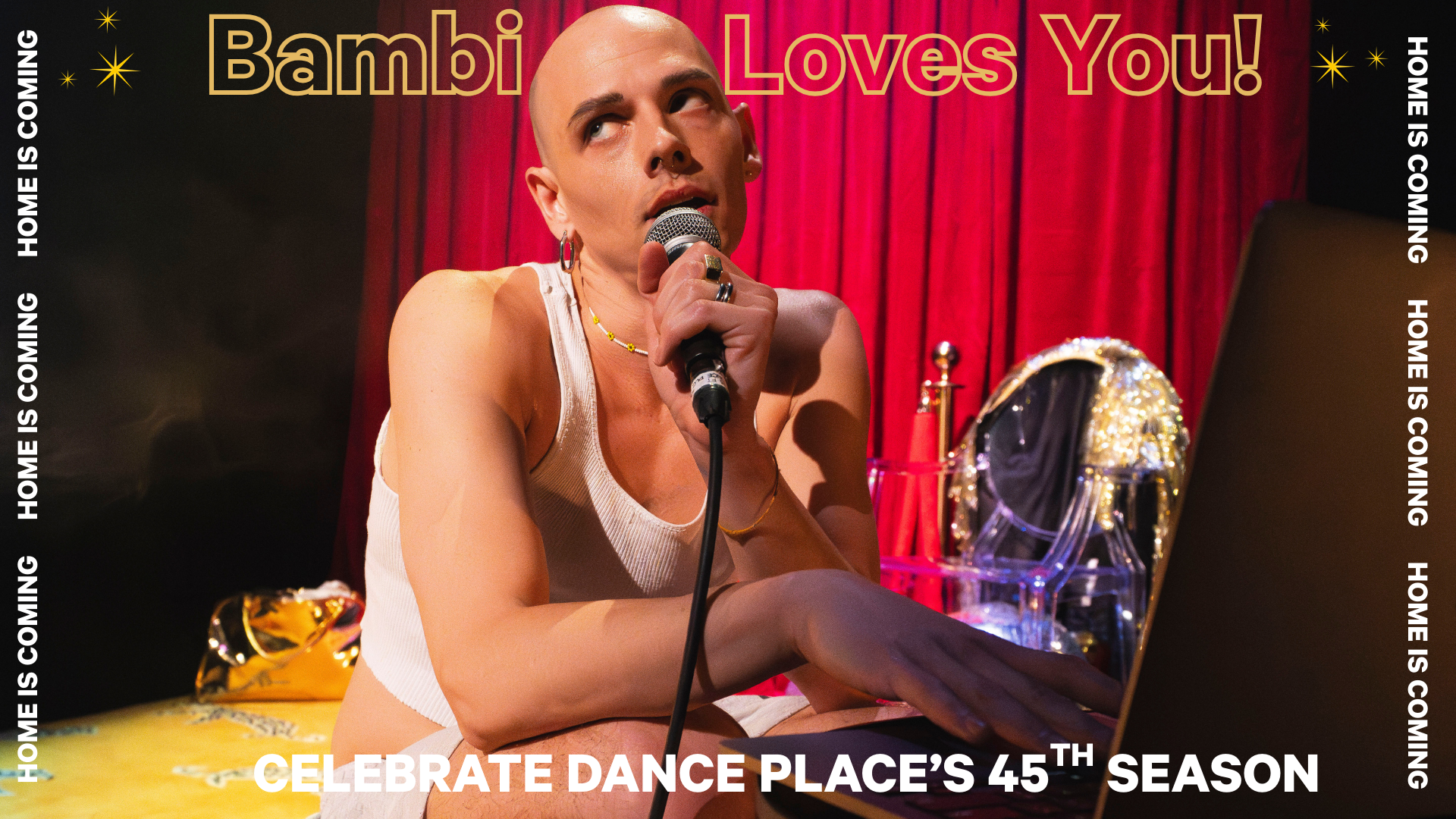
Celebrate Valentine’s Day at Dance Place with Bambi!
Whether you’re coming with your besties, a date or just your fine self, this February 14, Bambi Loves YOU! Bambi Loves You! is an all-dance, all-camp cabaret featuring s’mores, storytelling, and a healthy dose of make-believe. With performances at 6:00 PM and 8:00 PM, the schedule is designed to fit perfectly around whatever romantic (or platonic!) plans you have for the holiday.
As part of our ongoing Artist Advisory Council interview series, Dance Place’s Audience and Community Engagement Apprentice, Juliana Pironti, went on a coffee date with Bambi to discuss their artistic journey, what the show is all about and more.
Robert Wolfter, whose friends call them Bambi, is a local artist, choreographer, dancer, and educator who, famously, “makes everything an art project.” Growing up in a boarding house in Tennessee, Bambi learned the art of hospitality at a young age. “Home feels like being ready to host,” they explain.
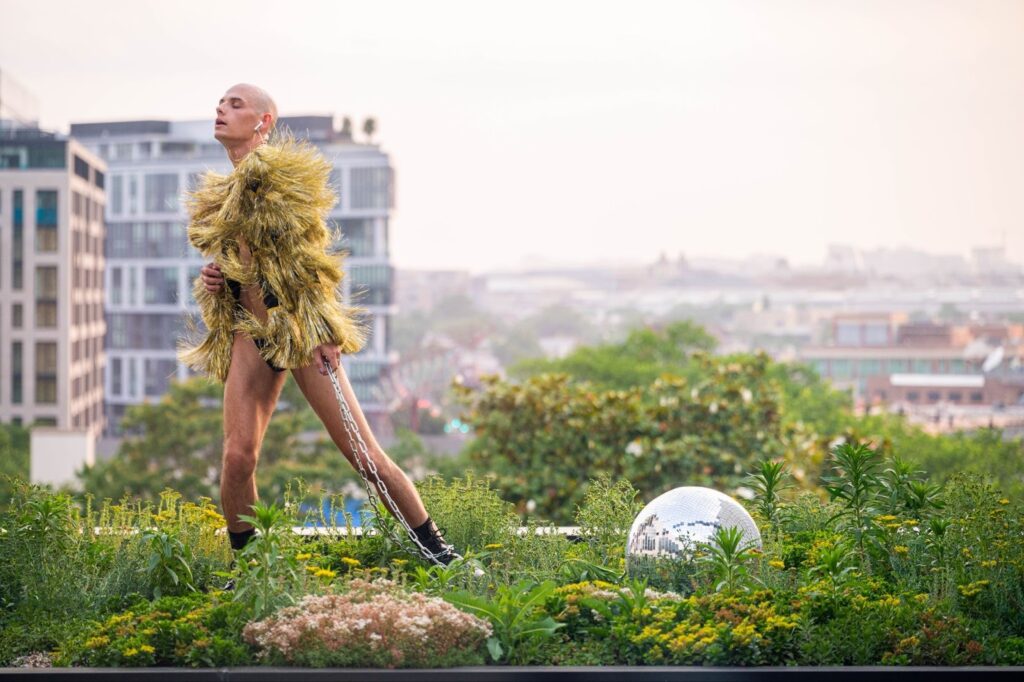
Through their “compulsion to navigate space and attend to everyone’s needs” they have created open spaces for community and connection in the DMV, Haus of Bambi and Club Haus. Haus of Bambi is a collective of artists who aim to create “genderless and gendermore spectacles for the stage, screen, and nightclub that complicate any single understanding.” In comparison, Club Haus is a social club that creates safe spaces for partying, prancing, and dancing all around DC. The concept of Bambi is much bigger than any one individual; it strives for the constant realization and reinvention of possibilities and plays a fundamental role in gathering and celebrating art.
You are not only a dancer and choreographer, but you also are the host/founder of Haus of Bambi and Club Haus. Could you delve deeper into why these spaces were created, what need you saw within the community, and how that relates back to your dance practice?
So me [being] a host is because of the boarding house I grew up in. I also have an appreciation for how intimidating it is to show up to a new room. It’s very intimidating to want to go see art or see a show and have never been to the building before. And I don’t like that. It feels really good to have someone open the door for you, but if not, open the door yourself: be right inside to greet people and help orient them, because that lowers everyone’s anxiety. So then, whatever happens next, we’re all better off. The world is chaotic; to cross the threshold is a transition process.
And so as a host, I think my talents are best served as just being the goofy, smiling face, like, “Hi, welcome. Bathrooms are over there, the bar is over there. The show starts at 7:30. Here’s a joke.”
So yeah, it keeps coming back to giving a map of the space so it doesn’t feel scary. Because the unknown is scary to walk through.
What can audience members expect seeing this show, other than a warm welcome? Why Valentine’s Day?
I am making everything an art project in my life, and I am also just telling the story that’s in front of me. Each time I’m making art, I can’t know all the steps until I’ve taken three or four and then changed my mind or found inspiration and gone somewhere else. You have to start. The details don’t become clear until they do. I generally knew the show I wanted to make, and then that date, Valentine’s Day, became available, and it was fully like, I’m taking that right now. That adds to the story, that’s more detail to what I’m constructing.
All of the context around my work matters. So if you come to the theater to see my show, it matters that you came on Valentine’s Day. It matters whether you came with a friend, a date, or by yourself. All of those things are part of the show. It’s not all Cupids and hearts and turning each other on, but all of that is part of what I’m hoping to facilitate, that we’re coming together on Valentine’s Day. There are two shows, so you can have dinner and then come to the later show, or come to the earlier show and then go out and talk about it. Whatever the night needs to be.
I’m also trying to make sure, in a really unpredictable time, that we can keep our date plans. I’m telling you six months out that I will be here on Valentine’s Day, and I want you to trust that. Even if everything else has fallen away, you can trust that this Valentine’s will happen.
Valentine’s Day is such a relational holiday, whatever that looks like: Galentine’s, friends, dates, solo. Having the option to know something is happening and that you can go however you want is comforting.
Yeah, because part of making everything an art project is lowering the stakes. Whatever the plan was, doesn’t matter. What we can do is what we’re doing. If the show was supposed to be in November and my creative process was supposed to look a certain way – things happen. Things change. The thing didn’t exist yet. So why be tied to what the world should have looked like for my work to exist? My work gets to be because the world is what it is.
Shifting a bit, I really loved how you state on your website that you “learned to hate dance… at certain institutions,” and I feel like you can ask any dancer and they have had this or a similar experience. Can you talk about how you went about dismantling these harmful, learned “techniques” and how you continue to find joy in your work?
When I was two, I told my parents I was going to be a dancer, and when I was four, we saw Alvin Ailey [Dance Theater], and I asked my parents how long before I could dance with my shirt off. And then I started. You know when you’re from a small town, the only thing is the one ballet class. So it was me and six to seven girls and nobody to give advice on, “Oh, as a guy in dance, this is where to shop for tights, this is where to get a shirt, this is where to do all the things.” There’s a lot of not orienting that happens; you’re the odd one out.
So each of these conservatories that I progressively went to is sort of like, that’s the track. You know, if you’re, I guess it’s ballet. I got lots of compliments, and apparently I have great legs. So it just seemed like, “Okay, we’ll follow the path that’s there.”
And it wasn’t until the last couple of years that I could really appreciate how I wasn’t happy in those spaces, because they were all these very classical conservatory settings that were asking me to have a relationship with my body that wasn’t expansive. And I’m happy to learn the rules you want to teach me, but you cannot tell me those are the only rules.
And now, my latest running definition for dance is that dance is conscious movement. Dance exists in my head and how I think of things. Dance is the only art form where I’m not required to have anything else. Therefore, it cannot be stolen from me. I don’t have to have a brush. I don’t have to have a roof over my head and a dry canvas. I don’t have to have metalworking tools with the right ventilation. I don’t have to keep my harp on me or my violin tuned. Dance cannot be taken. Any other art form can be taken, and therefore we are always dancers. Everyone should think of themselves as fundamentally a dancer, because that unlocks how your body, your nervous system, responds to the world. Our bodies think in ways our brains don’t. So we should let our bodies think.
You have many collaborators and thought partners within the Haus. How has this collaboration helped guide your practice, and why is it important to you to have this community around you?
I am a firm believer that you can’t know what you’re doing until you’ve started to do it, and then you turn around and see. And then you turn back around with more information so you can take the next steps.
So, the answer about collaborators: I did not know what I was doing at any point. It was fully… seeing. It was at my lowest point during the pandemic: processing [the] feeling like I may not ever be the creative voice again. And I started seeing other artists that were building worlds as big as the ones I hoped to build. So it was really just me thinking to myself: it doesn’t have to be me. Thank God it’s them, and I’m seeing it. Because I’m only ever wanting to make the work that I wish I had. We should be gathering around art, not alienating people through it.
As I started seeing these other artists in D.C. and the world was opening up again, it was also a specific moment in time where the identity of the city, the identity of the arts, and the arts’ relationship to audiences was completely shattered. To see people come charging out the gate into whatever this new world was, I just got to see the people I wanted to know more. That was how it started.
And now we’re on the fifth season of Haus of Bambi. There are six of us, and it’s slowly built into understanding not just who I’m drawn to, but who is drawn to each other. So the house is the six of us so far: Miss Grace David, Bambi, Bumper, JaxKnife Complex, King Molasses, and Farrah Skeiky.
I have internalized that people like to look at me. I’m from a very small town, and I’m actually very uncomfortable with people looking at me, which is why I like to host. I can control every interaction, but I can also drift away at any point because there will always be an excuse to be somewhere else and check in with someone else. I don’t really want to be the performer. I understand that even if I’m not trying, people are looking at me. If people are going to look at me, I want you to also know these people’s names. That is Haus of Bambi.
Art projects give us a reason to be together. They lower the stakes because all we’re doing is creating something that didn’t exist. If we stop deciding to make it, it stops existing.
This season at Dance Place, the theme is “Home is Coming,” and you describe Haus of Bambi as a (figurative) home for freedom and communion through art. How does the idea of “home” resonate with you? And how has Dance Place aligned with and supported this idea of “haus” and “home”?
Dance Place was my first stop when we moved to D.C. I didn’t know the city, I didn’t know the scene, and I found my way here and had coffee with someone who worked at Dance Place, and it was like… literally the cold call of an email, like, I’d love to get coffee. We went to the Starbucks Reserve around the corner. There was a little bit of a host energy.
So that energy set me up, even if it took multiple years to actually have a formal relationship with Dance Place. You know, I auditioned or applied for things and very much was not ready, very much was not planted enough. It just was incremental. Once I was greeted at the door, I just got to come back and be around and feel like there was a place from which to learn the city. And so I don’t take that idea of home at Dance Place lightly.
And then New Releases was my first thing. And that was when I had a dance film I made because I wanted to make something, but I didn’t know what I wanted to make. And another friend, Robert Priore, said, “You just have to make it. Like, just do it.” And so I found the two dancers that I was most comfortable with, who I had the easiest conversations with. It doesn’t have to be anything more than feeling easy around somebody. And we showed up at the studio and just started with nothing. And then we made that video for no reason, just to have made something.
And then I already had it and the New Releases application came up. Oh, here’s this video that I made because I just wanted to make something with people. And it just built from there. I was like, that was a conversation. That was me making something for myself that I was super fucking proud of, not trying to get something in by the deadline. Yes, please. Not like, “Oh, there’s an audition, I’m going.” No. Like, “Here’s my chance to have an audience.” That’s important, to have that kind of push for yourself.
But I think not enough people are making the work for themselves. They’re making it for that moment, the audience has got a ticket. And all of this work is just because I wanted to make something that I was proud of. So anything extra is just, thank God someone else liked it. But no one else needs to see it. I’m proud. Yeah.
And that taught me my next piece, and that taught me the next thing. So by the time I was Artist in Residence at Dance Place, the third time I applied, I had been turned down multiple times. I wasn’t ready. I wasn’t ready, which is so real. So when I was Artist in Residence, I could really think of it as, okay, I’m not trying to achieve anything other than what I can be really goddamn proud of here. It’s not reliant on whether this show sells out. It’s not reliant on anything.
It’s really incredible to have institutional support. But if you can put up the show that you’re proud of in your living room, you’ve made the art piece. And so Home is Coming is that idea, that we should all be making the work that we want, and then this is what it is for us to come together for it. But we’re already making it.
It’s coming. It’s coming. It’s all process. It’s constant. It’s not an arrival.